Street lighting, squares, school buildings, sports facilities — the public sector is responsible for a large share of the light that burns in Switzerland. We support municipalities and utilities from the survey to commissioning — with solutions that respect procurement law, the funding landscape and the local character.
05.1
Street and square lighting
Standard-compliant design to SN/EN 13201, energy-efficient LED installations, dynamic dimming via esave or Cititouch. Up to 90% energy savings compared with old installations — with better light quality.
05.2
Old-town and heritage lighting
Historic town centres need luminaires that suit the local character. We work with manufacturers of bronze and wrought-iron luminaires — and design the LED technology in invisibly behind them.
05.3
Procurement & tenders
We know the requirements of public procurement and supply tender-ready documents: bill of quantities, technical specifications, LDT data, maintenance plan. Clear statements instead of marketing.
05.4
How we support municipalities
In a municipality, several bodies are involved in every lighting project: the building administration, the utility, the committee and the municipal council. We supply documents that each of these bodies can understand. The technical process is described on our page on public lighting design.
- 01
Preparing the credit application The preliminary study produces a cost estimate with variants on which the municipal council can base its credit application. We show eligible parts such as sports halls or sports grounds separately, because grants may be available for them.
- 02
Requirements and organisation Together we define the requirements document and project organisation: who decides, who accepts the work and who will operate the installation later. We involve the utility that takes over maintenance from the outset.
- 03
Public tender under procurement law The tender documents describe services by function and make bids comparable. Besides price, life-cycle costs and sustainability can also be weighted as award criteria, as procurement law provides.
- 04
Townscape and heritage protection In village centres and residential areas we match light colour, shielding and luminaire design to the townscape and to the recommendations of the Federal Office for the Environment (FOEN) on light emissions. Where façades are protected, we fix anchor points and span wires one by one with the municipality and the utility.
- 05
Implementation in stages We divide major renewals into stages that fit the municipal budget. Open sections can be bridged with temporary lighting if needed, for example with solar luminaires.
- 06
Handover to operation At acceptance you receive the acceptance report, maintenance plan and digital documentation, and we train the people who operate the installation on site. Control adjustments and periodic measurements can be covered by a maintenance contract.
05.5
Standards and procurement law
Which standard applies depends on the facility: streets and squares to SN EN 13201 with the SLG 202 guideline, sports grounds to SN EN 12193, schools and municipal administration to SN EN 12464-1. In administrative buildings, the values of this standard count as minimum values for workplaces. Our article on SN EN 12464-1 explains what the 2021 edition changes, from modified illuminance to table values for walls and ceilings.
Municipalities procure under cantonal law based on the Intercantonal Agreement on Public Procurement (IVöB), where the canton has joined it. Services may be described by function, and brand names may only be used with the addition “or equivalent”. With connected lighting and sensors, data protection and open interfaces come into play as well. Our article on Smart City Light for municipalities covers what to clarify before the first tender.
05.6
Funding: where municipalities receive grants
Neither ProKilowatt nor Lightbankplus provides a grant for streets, parks and pedestrian zones. Municipal buildings are a different matter: sports grounds and stadiums qualify, as does indoor lighting in schools, sports halls and administrative buildings if the energy demand of the new installation is below the ProKilowatt maximum value under SIA 387/4. ProKilowatt rules out other energy funding, but not Swisslos contributions to sports facilities.
ProKilowatt requires a grant of at least CHF 20,000. For smaller projects Lightbankplus is an option, with up to 30% or CHF 30,000 per project. The Mandach sports hall, for example, was funded through the Lightbank. Important for municipalities: an unconditional decision to proceed already counts as the start of the project, not just the order. ProKilowatt 2026 accepts applications until 1 November, and the details are in our overview of ProKilowatt 2026.
05.7
From our projects
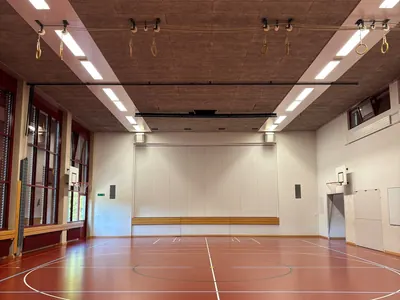
Mandach · August 2026
Mandach Sports Hall The municipality set a fixed time window, and the housings, wiring and ball-impact resistance were to stay. Because engineering and assembly of the conversion kit ran in-house, all that was left for the electrician on site was the quick mounting. The optimised lighting design earned funding through the Lightbank, and because every part can be replaced individually, the installation stays serviceable after the conversion too.
- Luminaires
- 20
- Control system
- DALI-2
- Installation time
- 1 week
05.8
Your contact
Marco Truninger personally supports municipalities, cities and cantons, from the first meeting with the building administration or committee to handover to the municipal works depot. If you are preparing a credit application, you receive the preliminary study and cost estimate in a form that can be presented to the municipal council.